You just hit send.
Then you looked again, and your stomach dropped.
The network was wrong. The crypto is gone from your wallet. And now you are staring at a transaction you cannot undo, wondering if you just lost everything.
First, breathe. You have not necessarily lost your money. But what happens next depends entirely on what kind of mistake was made, and most people panic and make it worse before they understand what is actually going on.
This post will explain exactly what happened to your funds in plain language, what your real options are, and how to avoid ever being in this position again.
Why This Happens (And Why It Is Not Entirely Your Fault)
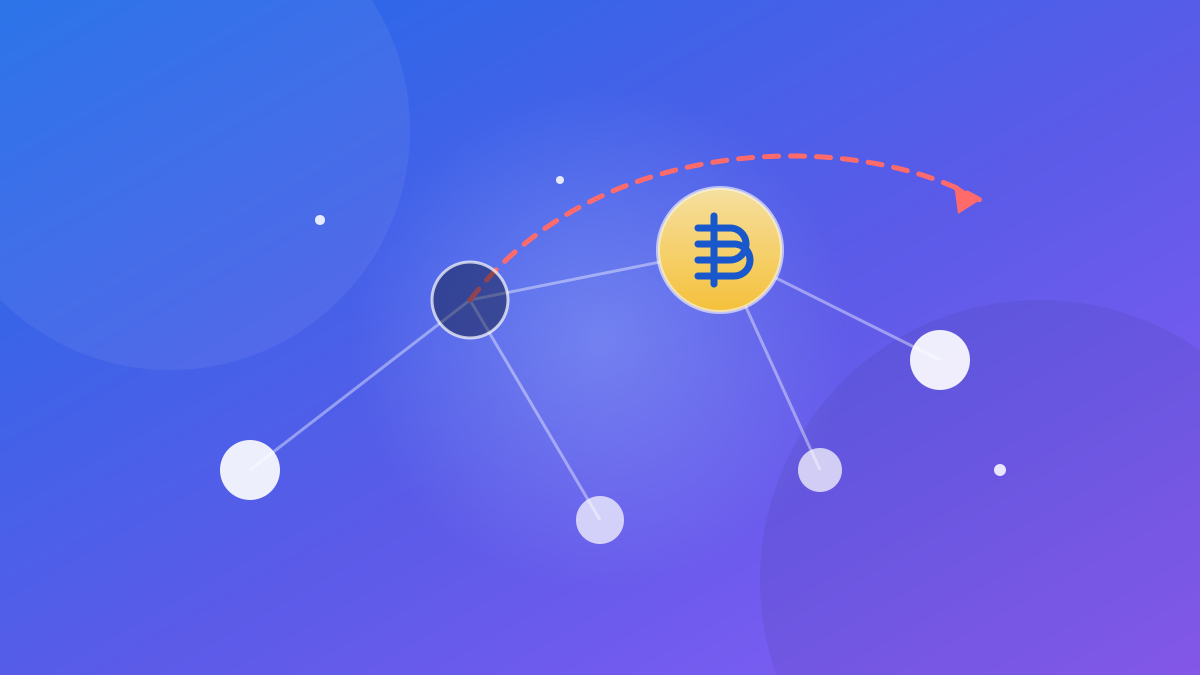
Most crypto wallet addresses look identical regardless of which network they belong to. An Ethereum address and a Binance Smart Chain address can look exactly the same. The same string of letters and numbers. The only difference is the network selected when sending, which is a small dropdown that is easy to miss or misread, especially on a phone screen.
So you copied the right address. You entered the right amount. You just selected the wrong network from that dropdown. And now your crypto appears to have vanished.
This is one of the most common mistakes in crypto. It happens to beginners and experienced traders alike. Reddit threads about it run hundreds of comments deep, full of people who lost money and people who recovered it. The difference between those two groups comes down to one thing: which of the three situations they were actually in.
The Three Situations (Only One Is Truly Permanent)
When someone says they sent crypto to the wrong network, it almost always falls into one of these three situations.
Situation 1: Same Address, Different Network
This is the most common situation and the one with the best outcome.
Your MTN SIM card number stays the same whether you are using it for calls, data or SMS. The number did not change. Only the service being accessed changed. Crypto addresses work the same way across EVM-compatible networks like Ethereum, Binance Smart Chain, Polygon, Arbitrum and Base. The same address exists on all of them at the same time. If you sent USDT using Ethereum when you should have used BSC, the funds arrived on the Ethereum network. They are not lost. They are just sitting on a different network than expected.
The recipient or you need to switch to that network in your wallet to see and access the funds. That is it. No permanent loss. Just a network switch.
Situation 2: Sent to an Exchange Using the Wrong Network
This situation is a little more stressful, but usually still recoverable.
A dispatch rider picks up your package and delivers it to the right building but enters through the back door instead of the front. The building receives packages from every entrance. The package is inside. Someone just needs to locate it in the system and bring it to you.
Most major exchanges control the same deposit address across multiple networks. When you send using the wrong network, the funds arrive at that same address through an unexpected route. Many exchanges detect this automatically and credit your account after their internal systems reconcile. If that does not happen, you raise a support ticket with your transaction ID and they locate and process it manually.
This is a support ticket situation. It can take days. Some exchanges charge a recovery fee. But your money is usually still there.
Situation 3: Completely Incompatible Networks
This is the painful one.
Nigeria uses naira. The UK uses pounds. You cannot walk into a Lagos market, hand over British pounds and expect change in naira. The currencies do not speak the same language and no amount of goodwill makes them compatible.
Bitcoin and Ethereum are built on completely different systems the same way. Their addresses are not the same format and they do not communicate with each other.
3a — Incompatible Address Formats
You know how MTN numbers start with 0803 or 0813 and Airtel numbers start with 0802 or 0812? The network can tell from the number format which carrier it belongs to.
Now imagine someone gives you a Glo number but you try to call it using a CDMA phone that only works with Visafone. The call does not go through. But worse, in crypto, the call actually goes through. The transaction confirms. Your money leaves. It just goes to a number that nobody is holding. Nobody picks up. The money sits there forever with no owner.
In a nutshell, If you send ETH toward a Bitcoin-format address, the funds most likely go to an address nobody owns or will ever claim. The number of possible addresses on Ethereum is so astronomically large that the odds of it accidentally landing in a stranger's wallet are almost zero. It simply goes nowhere. The transaction confirms on the blockchain and the funds leave your wallet permanently.
3b — Burn Addresses and Smart Contracts
In this case, you see those collection boxes outside churches or mosques where you drop cash donations? Once the money goes in, it is gone. You cannot reach back in and get it. Nobody is going to return it to you. It was designed to receive, not to give back.
A burn address works exactly like that. It was created specifically to receive crypto and never send it back out. Nobody owns it. Nobody controls it. The money goes in and disappears from existence permanently.
A smart contract is slightly different. Think of an ATM. An ATM is a machine that follows specific instructions: insert card, enter PIN, collect cash. If you walk up to an ATM and just shove loose cash into the card slot instead of using it properly, the machine was not built to handle that. Your money is stuck inside a machine that has no instructions for what to do with it.
That is what happens when you send crypto directly to a smart contract address that was not built to receive it. The money goes in and the contract has no code telling it what to do next. It just sits there. Locked forever.
This is rare compared to Situations 1 and 2, but it happens. And it is why understanding which situation you are in matters before you do anything else.
What to Do Right Now If This Just Happened to You
Do not send another transaction trying to fix it. That often makes things worse.
Follow these steps:
Step 1 — Find your transaction ID
This is a long string of letters and numbers generated when you sent the crypto. It is your receipt and your proof. Find it in your wallet history or the platform you sent from. Screenshot it.
Step 2 — Check which networks were involved
Was it two EVM-compatible networks like Ethereum and BSC? That is Situation 1 or 2. Was it Bitcoin to Ethereum or something completely different? That is Situation 3.
Step 3 — Check if the funds arrived
If both networks are EVM-compatible, search the recipient address on the network you sent through. If the funds show up there, they are not lost. They just need to be accessed from that network.
Step 4 — Contact the receiving platform with your transaction ID
If it went to an exchange, open a support ticket immediately. Provide the transaction ID, the amount, the asset, and the network you mistakenly used. The more clearly you explain it, the faster they can help.
Step 5 — Accept the outcome with the right information
If it is Situation 3 and the networks are completely incompatible, the funds are most likely gone. No platform can recover them. Focus on understanding what happened so it never happens again.
The Question Everyone Asks: What Are the Real Odds of Getting It Back?
Honestly, better than most people think, as long as it is not Situation 3.
If you sent between two EVM-compatible networks, recovery is almost certain. You just need access to the right wallet on the right network.
If you sent to an exchange using the wrong network, recovery depends on the exchange. Most major exchanges can handle it. Smaller or less reputable platforms may tell you it is unrecoverable even when it technically is not.
If the networks are completely incompatible, the odds are close to zero. The blockchain does not have an undo button.
This Is Exactly Why You Need a Platform That Guides You
The biggest reason this mistake keeps happening is that most crypto platforms were not built with the average Nigerian in mind.
They assume you already know what EVM means. They assume you understand the difference between TRC20 and ERC20. They show a small network dropdown and move on.
KclautX is built differently. Every step of the trading process is designed to be clear enough that you know exactly what you are doing before you confirm. Network options are labelled in plain language. The platform walks you through each action so there is no room for the kind of confusion that costs people money.
If you are ready to trade crypto in Nigeria on a platform that actually explains what is happening at every step, KclautX is where you start.
Trade crypto with confidence
Every step explained in plain language, so you always know what you’re confirming.
Frequently asked questions
If I sent crypto to the wrong network, is my money gone forever?
Not always. If both networks use the same address format, your crypto most likely arrived on the other network and can still be accessed. If you sent between completely different blockchain systems, recovery is unlikely. The first step is to identify which situation you are in before drawing any conclusions.
What should I do immediately after realising I sent to the wrong network?
Stop and do not send another transaction. Find your transaction ID from your wallet history, take a screenshot of it, and contact the platform involved with that information. Acting quickly with the right details gives you the best chance of recovery.
Can an exchange recover my funds if I used the wrong network?
Many exchanges can, especially for common network combinations like Ethereum and BSC. They often detect wrong-network deposits automatically or can process them manually when you raise a support ticket with your transaction ID. Some exchanges charge a recovery fee. Always contact them directly rather than assuming the funds are lost.
Why does this mistake happen so often in Nigeria?
Because crypto wallet addresses look identical across different networks. Most Nigerian traders are using mobile apps where the network dropdown is small and easy to overlook. Platforms rarely explain the difference between networks in plain language during onboarding, which means users learn about it the hard way. And on some platforms, the network dropdown does not warn you when you select an incompatible chain.
How do I make sure I never send to the wrong network again?
Always check the network setting twice before confirming any transaction. Confirm it matches exactly what the recipient or exchange specified. Never copy-paste an address and assume the network setting followed. On KclautX, every transaction step clearly shows the network being used so you always know what you are confirming before funds move.